M.A.X.: Mechanized Assault & Exploration
March 03, 2019 Filed in: Video Games
Recently, I uncovered a hidden gem of a computer game in M.A.X.: Mechanized Assault & Exploration. Interplay Productions released M.A.X. in 1996. Essentially a turn-based strategy game, it also featured a simultaneous turn-based option. This was probably offered to appeal to the rising popularity of real-time strategy games. I was unfamiliar with the title until I got it from GOG. I was very glad I did. It was one of the best strategy games I’ve played. Old reviews, such as this one from Computer Strategy Games Plus, were extremely positive. Very impressive for its time, I thought M.A.X. held up quite well after all these years.
The manual for M.A.X. was 106 pages. It was a bit overwhelming at first. I read the entire manual, including the eleven pages of background story. The game mechanics became a bit clearer after I finished the 15 training missions. Afterwards, I tackled the campaign’s nine missions:
The missions were fairly challenging and pretty lengthy. Many had a time limit of 100 turns. If I recall correctly, one was 150 turns. In M.A.X., there are three resources: raw materials, fuel, and gold. Buildings need to be connected to power to function. I thought base building was an enjoyable part of the game. With land, sea, and air units, variety was not a deficiency. The support units alone were plentiful including transports, scanners, surveyors, repair units, engineers, and supply trucks to name but a partial list. Combat units were no less varied with infantry, infiltrators, tanks, artillery, multiple ships, subs, and several planes. Bases could be outfitted with gun turrets, anti-aircraft, and similar defenses. One thing that was different from many strategy games is that M.A.X. didn’t feature a centralized resource pool. In other words, unconnected bases had their own sets of resources as did standalone units. For instance, you might have 150 materials in storage but an engineer, constructor, or repair unit might only have 10 materials on it. The unit could return to base to load additional units or you could drive a supply truck to it and transfer materials. There were a lot of nice touches like these in the game that presented additional levels of strategy and planning.
The final two missions were set on the same planet. Mission 8 had you playing base defense against waves of enemy attacks. Mission 9 flipped the script and tasked you with destroying the enemy’s very well defended base. If I want to keep playing after the campaign, there is still plenty left to do. M.A.X. includes 24 stand alone missions and 12 custom scenarios. You can also set up custom games with your own parameters. For $9.99 on GOG, you get M.A.X. and its sequel, M.A.X. 2. That is a heck of a bargain.
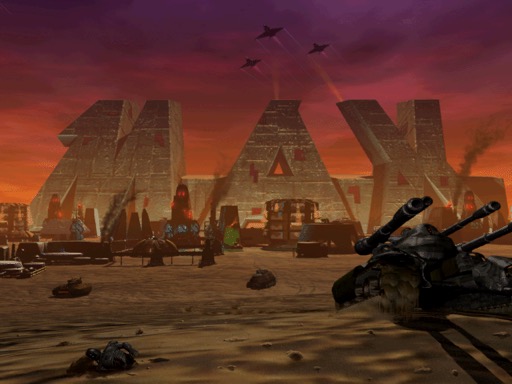
The manual for M.A.X. was 106 pages. It was a bit overwhelming at first. I read the entire manual, including the eleven pages of background story. The game mechanics became a bit clearer after I finished the 15 training missions. Afterwards, I tackled the campaign’s nine missions:
- Islands in the Sun
- Heart of the Matter
- Element of Import
- Stone Cold Deadly
- Slaugter Shore
- Repel Boarders
- Bastion of Rebellion
- Bright Hope
- Price of Freedom
The missions were fairly challenging and pretty lengthy. Many had a time limit of 100 turns. If I recall correctly, one was 150 turns. In M.A.X., there are three resources: raw materials, fuel, and gold. Buildings need to be connected to power to function. I thought base building was an enjoyable part of the game. With land, sea, and air units, variety was not a deficiency. The support units alone were plentiful including transports, scanners, surveyors, repair units, engineers, and supply trucks to name but a partial list. Combat units were no less varied with infantry, infiltrators, tanks, artillery, multiple ships, subs, and several planes. Bases could be outfitted with gun turrets, anti-aircraft, and similar defenses. One thing that was different from many strategy games is that M.A.X. didn’t feature a centralized resource pool. In other words, unconnected bases had their own sets of resources as did standalone units. For instance, you might have 150 materials in storage but an engineer, constructor, or repair unit might only have 10 materials on it. The unit could return to base to load additional units or you could drive a supply truck to it and transfer materials. There were a lot of nice touches like these in the game that presented additional levels of strategy and planning.
The final two missions were set on the same planet. Mission 8 had you playing base defense against waves of enemy attacks. Mission 9 flipped the script and tasked you with destroying the enemy’s very well defended base. If I want to keep playing after the campaign, there is still plenty left to do. M.A.X. includes 24 stand alone missions and 12 custom scenarios. You can also set up custom games with your own parameters. For $9.99 on GOG, you get M.A.X. and its sequel, M.A.X. 2. That is a heck of a bargain.