March 2019
Stargunner & Tyrian 2000
March 24, 2019 Filed in: Video Games
As a change of pace, I’ve been playing a couple of PC arcade shooters from the 1990s. The first is Stargunner, a 1996 release from Apogee Software. It is a horizontal side scroller similar to one of my all-time favorites, Jets’n’Guns. As with JnG, you have the ability to customize your ship with various weapons and defenses. That certainly adds to the replay-ability of an arcade genre game, which sometime grows stale with repeated play. For a 20+ year old title, it is definitely a fun game. It hasn’t hooked me like JnG did, however, so I doubt I will complete the entirety of its missions.
The other arcade shooter I’ve been playing is Tyrian 2000. This was an updated version of Tyrian, which was developed by Eclipse Software and published by Epic MegaGames. This game is a vertical scrolling shooter reminiscent of Xevious or Raptor: Call of the Shadows. Also like Stargunner, Tyrian provides for upgrades to ship components such as weapons, shields, and generators. I like Tyrian 2000 about as well as Stargunner. Both games are roughly the same vintage and they each provide a nice diversion when you get the itch for some retro arcade “shmup” (shoot-em-up) action.
Both games are available for free on GOG.
The other arcade shooter I’ve been playing is Tyrian 2000. This was an updated version of Tyrian, which was developed by Eclipse Software and published by Epic MegaGames. This game is a vertical scrolling shooter reminiscent of Xevious or Raptor: Call of the Shadows. Also like Stargunner, Tyrian provides for upgrades to ship components such as weapons, shields, and generators. I like Tyrian 2000 about as well as Stargunner. Both games are roughly the same vintage and they each provide a nice diversion when you get the itch for some retro arcade “shmup” (shoot-em-up) action.
Both games are available for free on GOG.
Apalachin Attack 2031 Season - Diamond .386 Champions
March 04, 2019 Filed in: Baseball
Playing again in the Diamond .386 League, we made a remarkable turnaround in 2031 going from worst to first. An 84-78 record was enough to lead our division by six games.
In the Division Series, the Apalachin Attack played the Htown .45s. The .45s had won 85 games so the series was expected to be evenly matched. After dropping the first two games in Houston, the Attack were revitalized by their return to Apalachin. Three straight wins gave Apalachin a come from behind series win. Carl Furillo was the series MVP.
The National Conference Championship featured the Apalachin Attack vs the wild card winner, the Fighting Jon Diesels. After winning the first three games, it appeared that the Attack might sweep the series. The Diesels put up a fight with a couple of wins before falling to defeat in game 6. The series MVP was Attack left fielder Kyle Tucker.
The Diamond .386 League Championship was between the Apalachin Attack and the Sonoma Dragons. The Dragons led the American Conference in home run hitting and had a fine pitching staff as well. Despite falling behind two games to one, the Apalachin Attack showed tremendous resolve. They were Dragon slayers as Apalachin prevailed and won the 2031 league title.
In the Division Series, the Apalachin Attack played the Htown .45s. The .45s had won 85 games so the series was expected to be evenly matched. After dropping the first two games in Houston, the Attack were revitalized by their return to Apalachin. Three straight wins gave Apalachin a come from behind series win. Carl Furillo was the series MVP.
- Game 1: Htown 4, Apalachin 3
- Game 2: Htown 7, Apalachin 6
- Game 3: Apalachin 8, Htown 3
- Game 4: Apalachin 2, Htown 2
- Game 5: Apalachin 5, Htown 4
The National Conference Championship featured the Apalachin Attack vs the wild card winner, the Fighting Jon Diesels. After winning the first three games, it appeared that the Attack might sweep the series. The Diesels put up a fight with a couple of wins before falling to defeat in game 6. The series MVP was Attack left fielder Kyle Tucker.
- Game 1: Apalachin 2, Fighting Jon 1
- Game 2: Apalachin 3, Fighting Jon 2
- Game 3: Apalachin 2, Fighting Jon 0
- Game 4: Fighting Jon 8, Apalachin 3
- Game 5: Fighting Jon 2, Apalachin 1
- Game 6: Apalachin 5, Fighting Jon 4
The Diamond .386 League Championship was between the Apalachin Attack and the Sonoma Dragons. The Dragons led the American Conference in home run hitting and had a fine pitching staff as well. Despite falling behind two games to one, the Apalachin Attack showed tremendous resolve. They were Dragon slayers as Apalachin prevailed and won the 2031 league title.
Apalachin Attack 2030 Season - Diamond Debut
March 04, 2019 Filed in: Baseball
After playing for the Gold .337 League Championship in 2029, the Apalachin Attack were promoted to the Diamond .386 League. I expected the competition was going to be strong in a Diamond Level league and I wasn’t wrong. Early in the season, we played pretty well. At the end of July, our record was a respectable 56-51 and we were in the mix for a wildcard spot. Unfortunately, we faded down the stretch and ended up 77-85, which put us in last place in the National Conference East division. Center Fielder Andrew McCutchen was one of the few bright spots on the 2029 team. He put up solid numbers, including a personal best 22 home runs.
M.A.X.: Mechanized Assault & Exploration
March 03, 2019 Filed in: Video Games
Recently, I uncovered a hidden gem of a computer game in M.A.X.: Mechanized Assault & Exploration. Interplay Productions released M.A.X. in 1996. Essentially a turn-based strategy game, it also featured a simultaneous turn-based option. This was probably offered to appeal to the rising popularity of real-time strategy games. I was unfamiliar with the title until I got it from GOG. I was very glad I did. It was one of the best strategy games I’ve played. Old reviews, such as this one from Computer Strategy Games Plus, were extremely positive. Very impressive for its time, I thought M.A.X. held up quite well after all these years.
The manual for M.A.X. was 106 pages. It was a bit overwhelming at first. I read the entire manual, including the eleven pages of background story. The game mechanics became a bit clearer after I finished the 15 training missions. Afterwards, I tackled the campaign’s nine missions:
The missions were fairly challenging and pretty lengthy. Many had a time limit of 100 turns. If I recall correctly, one was 150 turns. In M.A.X., there are three resources: raw materials, fuel, and gold. Buildings need to be connected to power to function. I thought base building was an enjoyable part of the game. With land, sea, and air units, variety was not a deficiency. The support units alone were plentiful including transports, scanners, surveyors, repair units, engineers, and supply trucks to name but a partial list. Combat units were no less varied with infantry, infiltrators, tanks, artillery, multiple ships, subs, and several planes. Bases could be outfitted with gun turrets, anti-aircraft, and similar defenses. One thing that was different from many strategy games is that M.A.X. didn’t feature a centralized resource pool. In other words, unconnected bases had their own sets of resources as did standalone units. For instance, you might have 150 materials in storage but an engineer, constructor, or repair unit might only have 10 materials on it. The unit could return to base to load additional units or you could drive a supply truck to it and transfer materials. There were a lot of nice touches like these in the game that presented additional levels of strategy and planning.
The final two missions were set on the same planet. Mission 8 had you playing base defense against waves of enemy attacks. Mission 9 flipped the script and tasked you with destroying the enemy’s very well defended base. If I want to keep playing after the campaign, there is still plenty left to do. M.A.X. includes 24 stand alone missions and 12 custom scenarios. You can also set up custom games with your own parameters. For $9.99 on GOG, you get M.A.X. and its sequel, M.A.X. 2. That is a heck of a bargain.
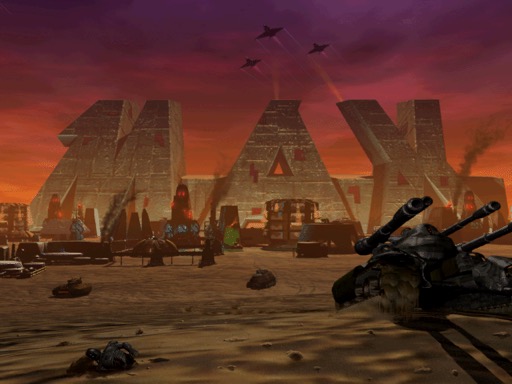
The manual for M.A.X. was 106 pages. It was a bit overwhelming at first. I read the entire manual, including the eleven pages of background story. The game mechanics became a bit clearer after I finished the 15 training missions. Afterwards, I tackled the campaign’s nine missions:
- Islands in the Sun
- Heart of the Matter
- Element of Import
- Stone Cold Deadly
- Slaugter Shore
- Repel Boarders
- Bastion of Rebellion
- Bright Hope
- Price of Freedom
The missions were fairly challenging and pretty lengthy. Many had a time limit of 100 turns. If I recall correctly, one was 150 turns. In M.A.X., there are three resources: raw materials, fuel, and gold. Buildings need to be connected to power to function. I thought base building was an enjoyable part of the game. With land, sea, and air units, variety was not a deficiency. The support units alone were plentiful including transports, scanners, surveyors, repair units, engineers, and supply trucks to name but a partial list. Combat units were no less varied with infantry, infiltrators, tanks, artillery, multiple ships, subs, and several planes. Bases could be outfitted with gun turrets, anti-aircraft, and similar defenses. One thing that was different from many strategy games is that M.A.X. didn’t feature a centralized resource pool. In other words, unconnected bases had their own sets of resources as did standalone units. For instance, you might have 150 materials in storage but an engineer, constructor, or repair unit might only have 10 materials on it. The unit could return to base to load additional units or you could drive a supply truck to it and transfer materials. There were a lot of nice touches like these in the game that presented additional levels of strategy and planning.
The final two missions were set on the same planet. Mission 8 had you playing base defense against waves of enemy attacks. Mission 9 flipped the script and tasked you with destroying the enemy’s very well defended base. If I want to keep playing after the campaign, there is still plenty left to do. M.A.X. includes 24 stand alone missions and 12 custom scenarios. You can also set up custom games with your own parameters. For $9.99 on GOG, you get M.A.X. and its sequel, M.A.X. 2. That is a heck of a bargain.